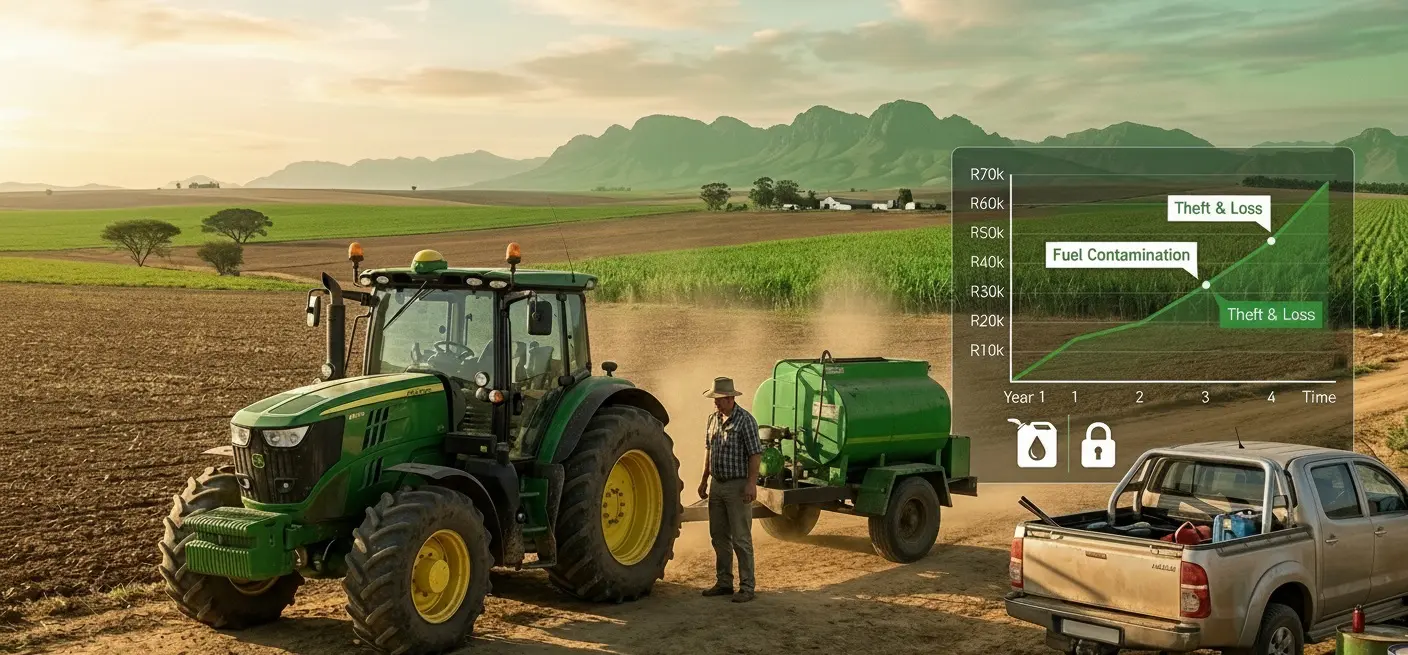
Agriculture Runs on Diesel
Farming in South Africa is a fuel-intensive operation. Every phase of the production cycle, from tillage and planting through irrigation and harvesting to transport, depends on diesel. Unlike most inputs where purchase and consumption happen close together in time, diesel is stored on-site in bulk and drawn across dozens of machines and operators over weeks and months. That combination creates both significant cost exposure and a control challenge that many operations manage with limited visibility.
On most South African grain and mixed farming operations, diesel represents 12 to 18% of total production costs. On a medium-to-large operation running 2 000 to 5 000 hectares, that is a fuel bill running into seven figures annually. It is also a cost that responds well to management, unlike weather or commodity prices, where what gets measured tends to improve.
The Machines and What They Use
Understanding farm fuel costs starts with knowing what the main equipment actually consumes.
- Combine harvesters: the single highest-consumption machine on most grain farms. A large combine running at capacity uses 50 to 60 litres per hour. A 450-horsepower model operating for 12 hours during harvest draws 600 to 700 litres in a single day. Two combines running simultaneously during peak harvest can pull 2 000 litres or more from storage daily.
- Tractors: consumption varies significantly by engine size and implement. A 200 to 300-horsepower tractor doing deep tillage uses 20 to 35 litres per hour. Lighter operations like spraying or spreading drop that to 10 to 15 litres per hour.
- Irrigation pumps: diesel-driven pivot and flood irrigation systems run continuously during dry periods, often 24 hours a day for weeks. For operations relying on diesel prime movers rather than mains electricity, irrigation can rival harvest machinery as a fuel load during summer months.
- Generators: persistent load-shedding has added a fuel demand that was not part of traditional farm planning. Cold storage, dairy milking equipment, pack houses, and grain dryers all require reliable power, and generators running four to six hours daily accumulate significant consumption across a month.
Seasonal Peaks and Supply Risk
Agricultural fuel demand is not steady throughout the year. It spikes sharply during planting and harvest, when machines run hard for weeks at a time and downtime carries direct yield consequences. A combine that cannot run on day three of a narrow harvest window is not an inconvenience; it is a yield loss that cannot be recovered.
The practical risk is that supply disruptions have not been limited to off-peak periods. South Africa has faced diesel supply constraints linked to refinery capacity and distribution infrastructure, and the consequences fall hardest on operations whose timing is dictated by crop maturity rather than fuel availability.
Operations with on-site bulk storage have a meaningful buffer against these disruptions. Managing minimum stock levels, reorder triggers, and delivery verification becomes significantly more important when supply is unpredictable. An operation that runs dry at the wrong moment does not simply pause; it loses output.
Theft on Farms
Agricultural fuel theft is a growing problem in South Africa. Farms typically store thousands of litres of diesel in relatively remote locations with limited overnight oversight. During planting and harvest, additional contractors and seasonal workers are on the property, creating more access points and reducing the informal oversight that a small permanent staff provides.
Theft on farms takes several forms:
- Direct siphoning: from bulk tanks or mobile bowsers overnight or during quiet periods
- Container theft: filling portable containers during shifts for removal from the site
- After-hours access: by those with legitimate daytime credentials using a shared key or unmonitored dispensing point
- Consumption masking: a worn injector or poorly maintained machine can increase fuel use by 15 to 20%, providing cover for gradual theft that stays within what appears to be normal variance
The agricultural context makes several of these patterns harder to detect than on a fixed commercial site. Machines operate across large areas, consumption is genuinely variable depending on soil conditions and load, and bulk tanks may only be physically inspected once a week or less.
The SARS Diesel Rebate
One of the most financially significant and least consistently utilised benefits available to South African farmers is the SARS diesel refund scheme. It allows VAT-registered primary producers to claim a refund on the General Fuel Levy and Road Accident Fund levy components of diesel purchased for qualifying primary production activities.
Qualifying activities include crop production, animal husbandry, and associated operations. Claims are currently processed through the VAT 201 return on eFiling, though SARS is transitioning to a new standalone diesel refund platform. The refund represents a direct reduction in fuel costs at current levy rates.
From 1 April 2026, the claimable percentage increased from 80% to 100% of qualifying diesel consumption — a significant improvement that materially increases the value of the rebate for operations that are correctly registered and maintaining adequate records.
To participate, farming operations must meet the following requirements:
- Register separately: using form VAT101D, in addition to standard VAT registration
- Log all eligible usage: consumption must be recorded by machine and activity type, since not all diesel use qualifies
- Retain records for five years: all purchase invoices, consumption logs, and supporting documentation must be available for audit
- Distinguish qualifying from non-qualifying use: diesel in road vehicles travelling on public roads does not qualify; field machinery, stationary equipment, and irrigation systems generally do
For an operation consuming 100 000 litres annually in qualifying activities, the rebate represents a significant recovery. Many farming operations either have not registered, or are claiming conservatively due to incomplete records, leaving substantial money unclaimed each quarter.
Why Record-Keeping Fails in Practice
The rebate exists. The challenge for most operations is proving the claim to SARS.
SARS audits diesel rebate submissions. An operation that cannot produce machine-level consumption records, cross-referenced with purchase invoices and tank records, is at risk of having its claim disallowed. Claiming more than can be substantiated creates penalty exposure; claiming less than was actually used simply leaves money on the table.
Manual record-keeping in an agricultural environment is genuinely difficult. A tractor may do qualifying field work in the morning and non-qualifying transport on a public road in the afternoon. Operators filling from a shared bulk tank may not record the exact volume drawn against each machine. Paper records are easy to lose, incomplete by nature, and difficult to aggregate into the format a SARS audit requires.
The result is that a portion of farming operations does not claim the rebate at all, and many that do claim it conservatively and without the level of documentation that would withstand scrutiny.
Where Fuel Management Systems Help
A fuel management system addresses several of these challenges at the same time.
Per-machine consumption records are generated automatically. Because every dispensing event is authenticated by machine tag or operator PIN and recorded with timestamp and volume, the system builds exactly the machine-level usage record that SARS requires. At VAT submission time, generating a report of diesel dispensed to each qualifying machine is a matter of exporting the data, not reconstructing it from memory.
Theft detection comes from continuous reconciliation. The sum of all authenticated dispensing transactions should match the tank level drop over the same period. A gap between those two figures is flagged automatically. A sudden unexplained level drop at night, with no corresponding dispensing record, generates an alert before the next morning.
Delivery verification is documented in real time. If a delivery claims 5 000 litres but the tank level rises by only 4 600, the discrepancy is recorded immediately with a timestamp and can be queried before the delivery vehicle leaves the site.
Consumption benchmarking helps identify mechanical issues before they become breakdowns. A combine whose litres-per-hectare consumption drifts upward over several weeks is signalling a maintenance need, whether a worn injector, a clogged filter, or an air intake restriction. Catching it through consumption data costs far less than an unplanned breakdown during harvest.
The Numbers
At current levy rates, the SARS rebate on 100 000 litres of qualifying usage represents a meaningful annual recovery. That figure depends on claiming correctly and having records that would satisfy an audit.
A 5% theft or waste rate on the same volume is 5 000 litres, or approximately R130 000 at current diesel prices. Between the rebate, loss prevention, and early detection of mechanical issues through consumption data, the financial argument for proper fuel management on a South African farm is not a marginal one. Most operations are currently leaving money on the table in several places at once.
R2D Fuel designs and installs fuel management systems for agricultural operations across South Africa. Our systems monitor bulk storage tanks with 1-litre accuracy, record every dispensing transaction by machine or operator tag, and generate the per-machine consumption reports that support SARS diesel rebate claims. Contact us to discuss your operation’s requirements.