The Problem Nobody Tests For
Fuel theft gets attention because the loss is obvious, with litres going in and rands walking out the door. Water contamination is different. It is invisible, it accumulates gradually, and by the time the symptoms appear the damage is already done.
The result is that most operations only discover they have a water problem when a filter clogs, an injector fails, or an engine misfires. At that point the conversation has moved from prevention to repair, and repair costs for modern high-pressure diesel injection systems are significant.
Understanding how water gets into your fuel, what it does once it is there, and how to detect it early is one of the more cost-effective things a fleet or site manager can do. It is not a complicated undertaking. Most operations are simply not doing it.
How Water Gets Into Diesel Tanks
Water enters stored diesel through several pathways, some obvious and some not.
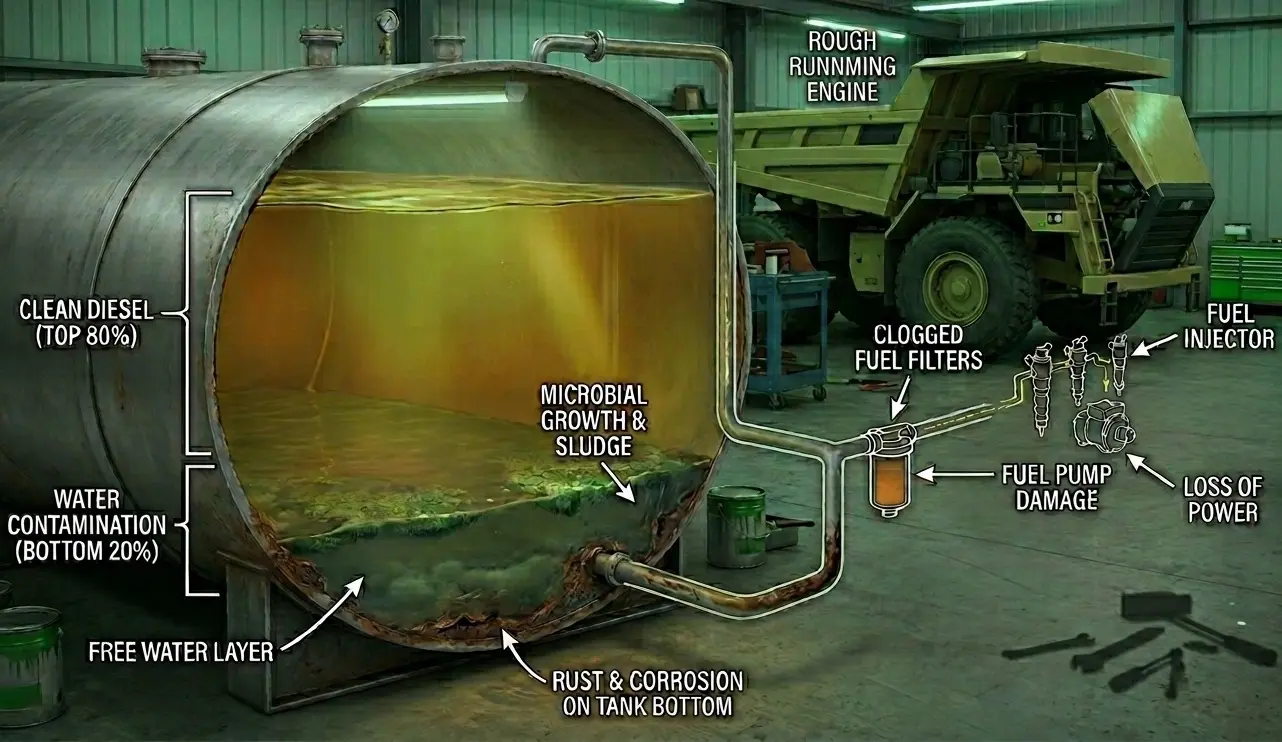
Condensation is the most common source and the hardest to eliminate entirely. As fuel is drawn down, air enters the tank through the vent. When temperatures drop at night, moisture in that air condenses on the cooler tank walls and settles to the bottom. Over weeks and months, this accumulates into a measurable water layer, even in a well-maintained, sealed tank.
Faulty tank infrastructure accelerates the problem. Corroded tank roofs, poorly fitted caps or lids, damaged vent pipes, and degraded seals all allow water ingress from rainfall, condensation, and humidity. A tank that has not been inspected in years is often allowing in far more moisture than the operator realises.
Contaminated deliveries are a less frequent but more acute source. If a delivery vehicle’s tank, hose, or fittings contain residual water, that water transfers directly into your storage tank. In high-volume operations where fuel is delivered regularly, even small amounts per delivery add up quickly.
Environmental exposure matters on sites where tanks are not properly protected. Fill points left open during rain, tanks in low-lying areas prone to flooding, and above-ground tanks with degraded coatings all present additional risk.
What Water Does to Your Equipment
Water and diesel do not mix. Water sinks to the bottom of the tank while diesel sits above it. The problem is that fuel is drawn from the bottom of the tank, which means the fuel reaching your injectors and pumps is the fuel closest to the water layer. In practice, some water is almost always drawn into the fuel system.
Injector damage is the most immediate and expensive consequence. Modern common-rail diesel injectors operate at pressures between 1 600 and 2 500 bar, with internal clearances measured in microns. Water has no lubricating properties at these tolerances, causing scoring, pitting, and seizure of precision components. In severe cases, water bypassing a fuel filter can cause injector tips to fail catastrophically. Injector replacement in South Africa costs upward of R1 200 per unit; on a six-cylinder engine, a full set replacement or refurbishment can reach R14 000 before labour.
Pump wear follows the same logic. Fuel pumps rely on diesel itself for lubrication. Water reduces that lubricity, accelerating wear on pump components and shortening service life significantly. Ultra-low sulphur diesel (the standard fuel in South Africa since 2017) is more susceptible than older diesel grades because the refining process that removes sulphur also removes some of the compounds that historically helped repel water.
Corrosion compounds over time. Water combines with naturally occurring acids in diesel to attack both ferrous and non-ferrous metals throughout the fuel system, including tank walls, fuel lines, injector bodies, and pump housings. The corrosion itself generates particulates that further contaminate the fuel.
The Diesel Bug: When Water Becomes Biology
Water at the bottom of a diesel tank does not just corrode metal. It also creates the conditions for microbial growth. Bacteria and fungi that live at the interface between fuel and water consume hydrocarbons as a food source and reproduce rapidly in warm conditions.
The result is commonly called diesel bug, a layer of dark, slimy biomass that forms at the tank bottom and on tank walls. As the colonies grow and die, they produce:
- Organic acids: which accelerate corrosion of tank walls and fuel system components
- Sludge: dead biomass that is drawn out with fuel, clogging filters and injectors
- Biosurfactants: which emulsify water into the fuel, making it harder to separate and remove
Diesel bug is not a rare or edge-case problem. Industry data indicates that untreated stored fuel typically begins showing contamination within 6 to 12 months. For operations with large on-site tanks that are refilled regularly rather than fully emptied and cleaned, microbial contamination is virtually inevitable without active monitoring and treatment.
The contamination is also self-reinforcing. Once established, a microbial colony survives partial tank draining because the biomass adheres to tank surfaces. Simply adding fresh fuel does not eliminate it.
South Africa’s Adulteration Problem
Water contamination from storage conditions is one risk. Receiving contaminated fuel in the first place is another, and in South Africa this risk is real and documented.
In January 2024, the Department of Mineral Resources and Energy sampled 1 000 petrol stations and found 70 selling adulterated diesel, most commonly diesel mixed with illuminating paraffin. Paraffin is significantly cheaper than diesel because it is not subject to the same fuel levies, creating a financial incentive for unscrupulous suppliers. Some tanks seized in subsequent operations contained mixtures with more than 50% paraffin.
Paraffin-adulterated diesel causes damage through different mechanisms than water, but the outcome is similar:
- Seal degradation: paraffin dissolves rubber seals throughout the fuel system
- Reduced lubricity: paraffin does not lubricate injectors and pumps as diesel does
- Engine knock: paraffin has a lower cetane number than diesel, causing incomplete combustion
- Injector failure: in high-concentration mixes, complete injector failure can occur within hours of running the engine
The challenge for businesses is that adulterated fuel looks and smells like diesel. Without testing, there is no way to detect the contamination at the point of delivery.
What South African Standards Require
Diesel quality in South Africa is regulated under SANS 342, the national standard for automotive diesel fuel, maintained by the South African Bureau of Standards (SABS) and enforced by the DMRE.
Key water-related limits under SANS 342 include a maximum water and sediment content of 0.05% by volume. The standard also specifies minimum cetane ratings, sulphur content limits, and density ranges, all of which are affected by adulteration with paraffin or other products.
The regulation exists to protect both equipment and consumers. The practical problem is that enforcement happens at the point of supply, not at the point of storage. Once fuel leaves a compliant depot and enters your tank, its quality is entirely your responsibility to maintain.
Detection: What Actually Works
Most operations rely on visual inspection and filter condition as informal indicators of fuel quality. Both are lagging indicators. By the time a filter is clogging with biomass or a technician notices dark, smelly fuel, the contamination has been present for some time.
More reliable detection methods include:
- Tank level sensors with water detection: modern magnetostrictive probes measure both fuel level and the depth of any free water layer at the tank bottom, to millimetre accuracy. A sudden increase in the detected water layer triggers an alert before the water reaches the draw point.
- Regular fuel sampling and testing: drawing a sample from the tank bottom at defined intervals (monthly for high-volume tanks, quarterly for lower-usage sites) allows visual inspection and, if required, laboratory analysis using Karl Fischer titration, the standard method for measuring dissolved water content precisely.
- Water detection pastes: applied to a dipstick, these change colour on contact with water. A quick and inexpensive manual check that can be done during routine site inspections.
- Delivery testing: drawing and inspecting a sample immediately after each delivery catches contamination at the point of receipt rather than weeks later.
Where Fuel Management Systems Add Value
A fuel management system does not replace laboratory testing or tank cleaning, but it does provide the continuous monitoring that makes early detection possible.
Tank level sensors installed as part of a fuel management system measure water accumulation in real time. When the water layer in a tank exceeds a defined threshold, an automated alert is sent by SMS or email immediately, before any contaminated fuel is drawn into vehicles or equipment.
This matters because periodic manual dips only catch the problem at the moment the check is done. A tank that passes a Monday morning dip can accumulate a significant water layer by Thursday if a delivery introduced moisture, and that water would be entering engines for three days before the next check.
The delivery verification function of a monitoring system also helps with the adulteration risk. If a delivery of 10 000 litres is recorded by the flow meter but the tank level sensor shows a density or level change inconsistent with clean diesel, the discrepancy is flagged immediately and the delivery can be queried before the fuel is used.
The Cost Argument for Prevention
The maths on prevention versus repair is straightforward. A full injector refurbishment on a single vehicle costs R14 000 or more. A haul truck or combine harvester sidelined for unplanned maintenance during a critical production period costs multiples of that in lost output.
Routine tank maintenance, regular sampling, and a monitoring system that alerts you to water accumulation cost a fraction of a single injector failure. The case for it is not complicated. Most operations have simply never been presented with the numbers clearly.
R2D Fuel’s tank monitoring systems detect water accumulation in real time, with automated alerts when contamination exceeds safe thresholds. Our sensors measure to 1-litre accuracy across all tanks simultaneously, giving you the early warning that prevents equipment damage before it starts. Contact us to discuss water monitoring for your site.