Mining’s Fuel Problem
South African mining is one of the most fuel-intensive industries in the world. Open-cast operations, which produce the bulk of the country’s coal, iron ore, and platinum group metals, run continuous diesel-powered cycles of drilling, blasting, loading, and hauling. Underground mines add ventilation, pumping, and underground equipment to that demand. The fuel bill on a large mine site is not a single line item. It is one of the primary operational cost drivers.
Industry analysis of open-cast operations puts diesel at 20 to 40% of total operating costs. At that scale, a 5% reduction in untracked waste represents millions of rands per year on a single site. And the range of controllable losses, from theft to unauthorised use to consumption that no one is measuring, is significant.
What the Equipment Actually Uses
The starting point for understanding mining fuel costs is knowing what the main equipment consumes.
- Ultra-class haul trucks: the single highest-consumption asset on most large open-pit operations. A CAT 793F under continuous load uses 145 to 193 litres per hour. A fleet of six haul trucks running a full 24-hour cycle draws between 20 000 and 28 000 litres per day from storage.
- Hydraulic excavators: a large excavator class machine uses 29 to 45 litres per hour under load. Multiple excavators working simultaneously on a loading face represent a significant baseload operating continuously across shifts.
- Front-end loaders and underground LHDs: medium to large wheel loaders draw 20 to 35 litres per hour. Underground load-haul-dump machines range from 8 to 30 litres per hour depending on payload class and gradient.
- Drill rigs: surface drilling rigs run extended shifts during blast preparation and consume at rates comparable to excavators on a per-kilowatt basis.
- Ancillary equipment: graders, water bowsers, light vehicles, compressors, and support equipment all add to the total. On a large operation this category alone can exceed the total fuel consumption of a smaller mine.
A medium-sized open-cast operation running 24 hours across these equipment classes burns volumes that make even a small percentage of untracked waste financially significant.
The Load-Shedding Compounding Effect
Load-shedding has added a fuel demand to South African mining that was not part of operational budgets before 2020. Mines that previously relied on Eskom power for workshops, processing facilities, ventilation systems, and site infrastructure have been forced to supplement or replace that supply with diesel generation.
During periods of severe load-shedding, some mines operated at 60% of normal production capacity as underground operations were temporarily suspended and surface processing slowed. Beyond the production impact, the diesel generators required to maintain critical systems represent a fuel cost that falls entirely outside primary equipment tracking and is often managed separately from bulk fuel stocks.
For operations with large generating capacity, generator fuel can account for a meaningful portion of total diesel spend, consumed at fixed sites with round-the-clock demand. Without integration into the central fuel management system, generator consumption is a blind spot that does not appear in equipment-level consumption reports.
Theft and Unauthorised Access
Mine sites have characteristics that make fuel difficult to secure. They are large, operate continuously across multiple shifts, employ significant numbers of contractors alongside permanent staff, and typically have several dispensing points distributed across the site. Bulk storage tanks are frequently located away from the main operations area and active supervision.
The scale of organised fuel theft in South Africa is documented. In a single year, 143 pipeline theft incidents resulted in 10 million litres stolen from Transnet infrastructure alone. On-site theft at mine facilities is harder to quantify because it rarely results in prosecution, but the mechanisms are consistent: opportunistic access to unlocked dispensing points, shared credentials, after-hours draws, and falsified records that align with authorised volumes.
Shift changes create particular exposure. Fuel drawn in the last hour of a shift, attributed to a machine that has already parked, is difficult to investigate days later. Contractors with legitimate daytime access may retain the ability to draw fuel outside working hours. And in operations where the same team maintains both the fuel records and the physical access, internal record manipulation is a documented risk across the industry.
The Management Problem at Scale
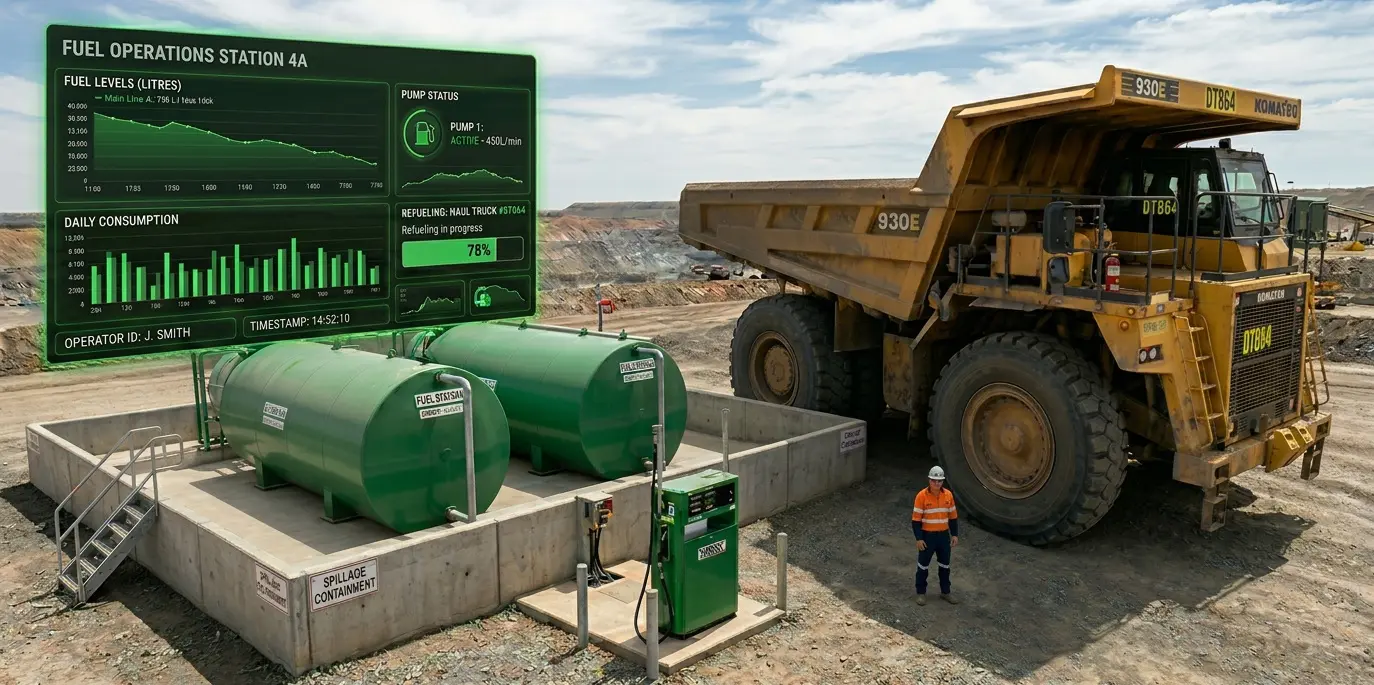
A mine is not a single dispensing point. A large open-cast operation typically has a main storage tank, one or more satellite tanks at active working areas, and mobile bowsers distributed across the pit to reduce haul truck downtime. Each represents a separate fuel flow that must be reconciled against the overall balance.
Without centralised monitoring, the picture management sees is an approximation at best. Monthly reconciliation against supplier invoices confirms how many litres came in and gives a rough figure for what was consumed, but it cannot tell you where a discrepancy originated, which machine or operator was responsible, or when it occurred. The resolution is too low to drive decisions.
The volume at stake justifies more than an approximation. A mine consuming 500 000 litres per month spends approximately R13 million on diesel at current prices. A 3% tracking gap is 15 000 litres and roughly R400 000 per month, more than R4.5 million per year, from a site that simply lacks the measurement infrastructure to see it.
What Operators Can Control
One frequently underestimated source of fuel cost variation is operator behaviour. Research published in South African mining journals indicates that haul truck and excavator operators can influence fuel consumption by up to 15% through technique alone. Idle time, gear selection, acceleration behaviour, and bucket fill factor all affect consumption in ways that management cannot see without the data.
Maintenance condition compounds the effect. Analysis of mine fleet maintenance programs found that condition-based scheduled maintenance can reduce fuel consumption by up to 10% and extend engine lifespan significantly. A machine running with a clogged air filter, a worn injector, or incorrect tyre pressure consumes more fuel than it should, and that overconsumption is invisible without consumption benchmarks to measure against.
Both levers require the same thing: machine-level consumption data over time, compared against a baseline. That data exists only if every dispensing event is recorded against the specific machine and operator that drew the fuel.
Where Fuel Management Systems Fit
A fuel management system addresses the monitoring gap directly.
- Tank level monitoring: tracks the fuel balance at every storage point in real time. Unexplained level drops, whether from a leaking valve, direct siphoning, or an unrecorded dispensing event, are visible immediately rather than at the next manual inspection.
- Tag-based dispensing control: links every fuel draw to a specific machine or operator credential. No valid authentication means no fuel flow. Every transaction is timestamped, volume-recorded, and transmitted to a central dashboard that exists outside the control of site personnel.
- Mobile bowser management: extends the same controls to field refuelling. A bowser fitted with a flow meter, controller, and cellular connectivity reports dispensing events back to the central system in real time, regardless of where in the pit it is operating. Location tracking integration allows bowser position to be cross-referenced against the machines actually refuelled.
- Delivery verification: documents tank level before and after each delivery. If a supplier’s docket records 20 000 litres but the tank level rises by only 18 500, the discrepancy is logged immediately and can be disputed before the vehicle leaves the site.
- Consumption benchmarking: generates per-machine and per-operator consumption reports over time. A haul truck whose litres-per-hour figure drifts upward over several weeks is signalling a maintenance requirement before it becomes a breakdown. An operator whose fuel use consistently exceeds fleet averages is a training conversation rather than a mystery.
The Commercial Case
For a mining operation consuming 500 000 litres per month, a 3% improvement in fuel accountability through better controls, delivery verification, and consumption visibility represents approximately R4.5 million per year in recovered losses. The cost of a professionally installed monitoring and control system across a multi-point mine site is a fraction of that figure, typically recovered within the first few months of operation.
For an industry where every rand of operational cost is scrutinised against declining grade profiles and global commodity prices, the arithmetic is not complicated. The question is not whether the losses exist. It is whether the operation has the measurement infrastructure to see them.
R2D Fuel designs and installs fuel management systems for mining and heavy industry operations across South Africa and the broader region. Our systems monitor multiple tanks simultaneously with 1-litre accuracy, support mobile bowser integration, tag-based dispensing control, and real-time SMS and email alerts across all dispensing points. Contact us to discuss your site requirements.