A Problem Nobody Talks About
Ask most fleet managers or site supervisors whether fuel theft is a problem at their operation and you will get one of two answers: a flat denial, or a resigned acknowledgement that yes, fuel disappears and no, they have never been able to pin it down.
Both responses point to the same underlying reality: fuel theft in South Africa is pervasive, largely invisible, and almost never successfully prosecuted without an electronic audit trail. The result is that most losses are quietly absorbed as an operational cost rather than investigated, which in turn means the true scale of the problem is almost certainly understated by official figures.
What is measurable is significant enough. SARS estimates that illicit fuel operations cost South Africa R3.6 billion annually. Losses of this scale are not the result of a few isolated incidents, they are the typical outcome when high-value liquid assets are stored and dispensed without systematic controls.
How Fuel Is Being Stolen
Understanding the methods is the first step toward building effective countermeasures. Fuel theft takes several distinct forms, each requiring a different response.
Opportunistic On-Site Theft
The most common form at commercial operations is opportunistic, meaning someone with legitimate access to the fuel dispensing area draws fuel outside of their authorised allocation. This includes:
- After-hours dispensing: to personal vehicles using a shared key or PIN
- Contractor overfilling: topping up vehicles or equipment beyond what was authorised
- Container theft: filling portable containers during shifts for off-site sale
- Direct siphoning: from storage tanks or mobile bowsers overnight
This type of theft rarely involves sophisticated equipment. It relies on the absence of oversight and the knowledge that manual logs can be manipulated or that discrepancies will only surface at month-end, if at all.
Internal Fraud and Falsified Records
Where employees are responsible for fuel recordkeeping, theft frequently involves record manipulation rather than just physical access:
- Ghost dispensing: recording fictitious fuel draws against real vehicles, with the excess drawn separately and removed from the site
- Short-delivery schemes: accepting a delivery for 10 000 litres, recording 10 000 litres on the docket, but only pumping 9 000 litres into the tank with the balance diverted elsewhere
- Odometer and hourmeter inflation: inflating usage readings to justify higher fuel consumption, masking the actual shortfall
The defining characteristic of all these methods is that they leave no obvious physical trace. Without an independent measurement system, the fraudulent record becomes the only record.
Driver and Contractor Theft
Route-based businesses face additional exposure from fuel drawn at third-party pumps. Drivers using company fuel cards at public service stations can fill their personal vehicle alongside the fleet vehicle, or visit stations outside their authorised route. Because the transaction appears legitimate in isolation, it only becomes visible when card data is reconciled against actual vehicle odometry and route data.
Contractors on-site present a similar problem. Without tag-based authentication, a contractor who has physical access to a dispensing point can draw fuel against any cost code, or draw fuel for equipment that is not on-site at all.
Organised Theft
At the larger end of the scale, South Africa has a well-documented organised fuel theft problem that primarily targets pipeline infrastructure but has downstream effects on business operations through supply disruption and adulterated product reaching the market.
In June 2025, a multi-province crackdown by SARS and SAPS seized nearly one million litres of contaminated diesel and confiscated R367 million in assets across 23 sites in Gauteng, Mpumalanga, and KwaZulu-Natal. The operation uncovered illegal fuel depots running mobile “fuel washrooms” that adulterated diesel with paraffin before reselling it through legitimate-looking channels.
A 2024 conviction saw a pipeline thief sentenced to 35 years after being caught siphoning 34 000 litres of petrol from a Transnet pipeline near Boschkop, with an illegal fitting welded directly into the pipe. Earlier data from Transnet showed 143 theft incidents in a single year, resulting in 10 million litres stolen.
The consequence for businesses is twofold, covering both supply disruptions during active theft periods and the risk of receiving contaminated product that causes serious engine damage. Diesel adulterated with paraffin breaks fuel system seals, corrodes injector components, and causes engine knock. The damage is expensive and the contaminated delivery receipt rarely provides legal recourse.
Who Bears the Losses
Fuel theft affects every sector that stores and consumes diesel in volume, but the exposure varies.
Fleet and logistics are the hardest hit in aggregate. Fuel already accounts for 68% of operational costs in large mixed fleets, with theft representing 4% of total annual fuel spend, meaning a business with a R20 million annual fuel bill loses around R800 000 per year to theft alone before any other waste is counted.
Mining operations carry compounded risk. High fuel volumes, remote locations, large numbers of shift workers and contractors, and complex supply chains all increase exposure. Adulterated diesel reaching a mine site is a particular concern: engines running on contaminated product fail earlier, maintenance cycles shorten, and the cost of downtime on a haul truck or excavator dwarfs the value of the fuel itself.
Agriculture faces seasonal spikes. Farms typically store large volumes of diesel on-site with minimal staff oversight, and the presence of contractors during planting and harvest seasons introduces additional access points. Combine harvesters consuming 30 to 60 litres per hour mean that even a modest theft event during peak season has significant operational consequences.
Construction deals with multi-site exposure. Fuel stored at project locations is difficult to monitor centrally, and the transient nature of construction workforces means accountability is harder to enforce than in a fixed operation.
Backup generator operations (hospitality, retail, manufacturing, and data centres) represent a different risk profile: smaller volumes, but often no fuel monitoring at all. Generator tanks are frequently accessed only during a service call, making theft undetectable until the tank reads empty during a power outage.
Why Prosecution Almost Never Succeeds
The statistics on successful prosecution of fuel theft are sobering. Transnet reported 264 pipeline cases over a three-year period, resulting in 155 arrests and only 2 convictions. For on-site theft, the conviction rate is no better, and most cases never reach court at all.
The core obstacle is evidence. Theft discovered at month-end reconciliation means the theft occurred days or weeks ago. The fuel is gone, the thief is long back at their normal routine, and there is no independent record of what actually happened. A paper log showing the authorised draw is useless if the actual draw was different and there is no physical record to contradict it.
Prosecution for theft in South Africa requires proof of unlawful appropriation and intent, beyond reasonable doubt. A discrepancy between a manual log and a month-end dip reading does not meet that standard. It is also useless for an insurance claim: because fuel theft is so difficult to prove, insurers rarely pay out on fuel theft claims, and the cost of fidelity insurance coverage is prohibitive for most operators. The losses are absorbed quietly.
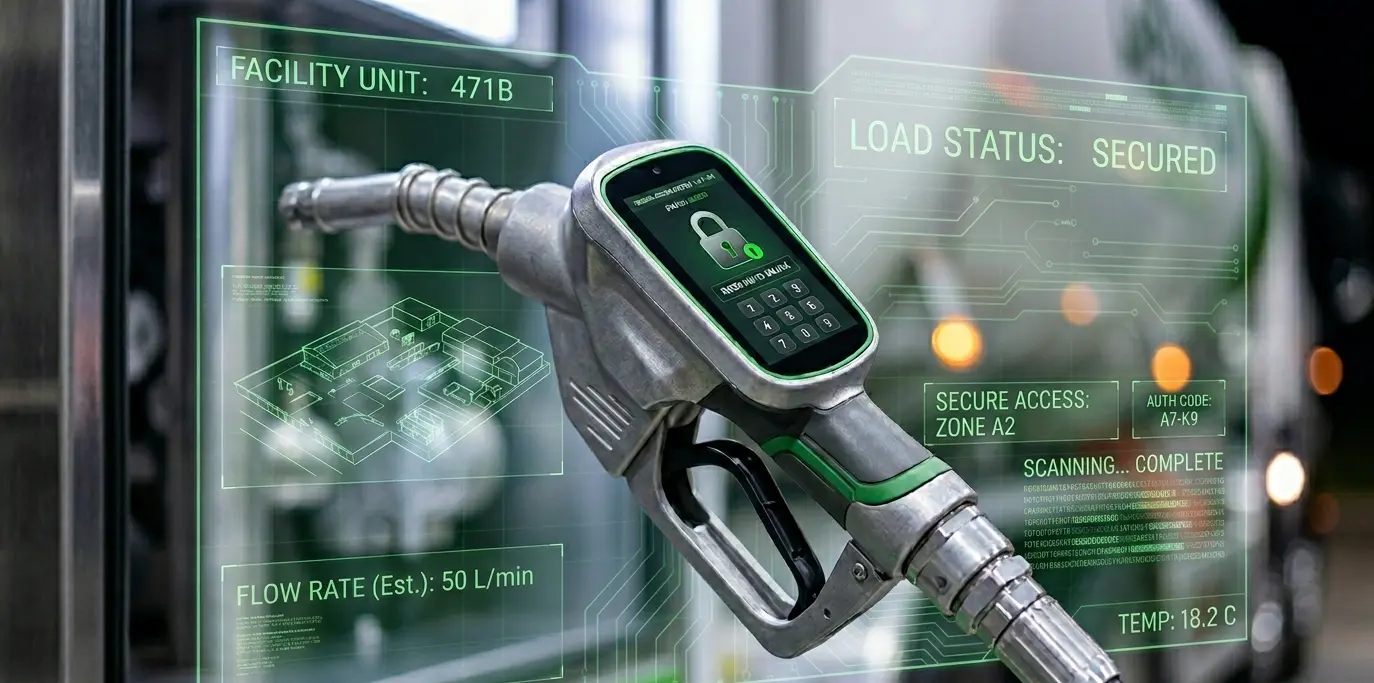
An electronic fuel management system changes this equation entirely. Every dispensing event is recorded automatically, timestamped, tied to a specific authenticated credential, and transmitted to a cloud server outside the control of anyone on site. A dispute becomes a retrieval exercise rather than a word-against-word argument. The data is admissible, it is precise, and it is available immediately rather than reconstructed from memory weeks after the fact.
What Effective Prevention Actually Looks Like
Physical controls such as padlocks, cameras, and fencing reduce opportunistic access but do not create accountability. A locked pump still cannot tell you who drew fuel or how much, and a camera does not stop someone who has legitimate access.
The methods that reliably reduce fuel theft share a common characteristic: they make every dispensing event traceable to a specific identity and verifiable against an independent measurement.
Tag or PIN authentication ensures every draw is linked to a person or vehicle. No credential, no fuel. This eliminates anonymous opportunistic draws and creates a direct audit trail.
Real-time tank level monitoring with 1-litre accuracy creates a second independent measurement. The sum of all authenticated dispensing events should match the tank level drop. Any discrepancy is flagged automatically rather than discovered at month-end.
Automated alerts mean that unusual events trigger a notification immediately, not at the next scheduled review. A sudden unexplained tank level drop at 02:00 generates an SMS within minutes. A dispensing event outside approved hours triggers an alert before the person drawing the fuel has left the site.
Delivery verification catches short-delivery fraud. If a delivery docket says 10 000 litres were delivered but the tank level only rose by 9 200 litres, the discrepancy is visible immediately and documented for dispute resolution.
Immutable cloud records ensure that the data exists independently of the on-site hardware. Deleting or tampering with the controller does not delete the cloud record of what it reported.
The Numbers Work
A mid-sized operation losing 5% of 40 000 litres per month to theft and waste is losing approximately 2 000 litres per month, or around R52 000 at current diesel prices. Recovering even half of that through better controls represents over R300 000 per year in direct savings, before accounting for reduced administrative burden, faster dispute resolution, and the value of having credible evidence if a theft case ever reaches disciplinary proceedings.
The return on a professionally installed system, for most operations of this size, is measured in months rather than years.
R2D Fuel designs and installs fuel management systems for operations across South Africa and the broader region. Our systems monitor up to nine tanks simultaneously with 1-litre accuracy, include tag-based authentication, real-time alerts, and immutable cloud records that provide an audit trail suitable for disciplinary and legal proceedings. Contact us to discuss your site requirements.