More Than a Lock on the Pump
A common misconception is that fuel control means padlocking the dispensing pump and keeping a paper log. That approach creates inconvenience without creating accountability. A modern fuel management system works differently, as it builds a digital record of every litre automatically, independent of the people drawing the fuel, and makes that record available in real time from anywhere.
Understanding how the components fit together helps you ask better questions when evaluating a supplier and set realistic expectations for what a system can and cannot do.
The Hardware Layer
A complete fuel management system is made up of several hardware components, each responsible for a specific part of the measurement and control chain.
The Fuel Level Sensor
Everything starts with knowing what is in the tank. A fuel level sensor is installed directly into the storage tank and measures fuel volume continuously, not once a day when someone does a manual dip, but in real time, every few minutes.
Accurate sensors read to within 1 litre across the full depth of the tank. This precision matters because it is the foundation for reconciliation. When you know the tank started the day at 12 450 litres and ended it at 11 830 litres, you can compare that 620-litre drop against the sum of every dispensing event recorded on the flow meter. Any gap between those two numbers is a discrepancy that needs an explanation.
Fuel level sensors also detect:
- Sudden unexplained drops: a characteristic signature of siphoning or a leaking valve
- Fuel additions: delivery verification without relying on the supplier’s docket alone
- Water ingress: water in diesel is a common cause of injector and pump damage and is difficult to detect without electronic monitoring
The Flow Meter
While the tank sensor measures bulk volume, the flow meter is installed at each dispensing point and measures exactly how much fuel passes through the nozzle during each individual transaction. Every fill is recorded, including the volume drawn, the time, and the duration of the dispensing event.
Paired with a controller that requires authentication before dispensing can begin, the flow meter creates a per-transaction record that can be matched to a specific person, vehicle, or machine.
The Controller
The controller is the brain at the dispensing point. Before fuel can flow, the controller requires an authenticated event, typically a key tag swipe, RFID card, or PIN code entry. No valid authentication, no fuel.
This single step eliminates the most common form of fuel theft: opportunistic draws from an unlocked pump by unauthorised personnel. It also removes plausible deniability. When every dispensing event is linked to a specific tag or PIN, the audit trail is tied to a person rather than a shift or a time window.
The R2D Controller features a remotely adjustable LCD display with adjustable brightness for clear visibility in all conditions, from bright sunlit yards to covered machine bays at night.
Hrs/Kms Capture
For operations where fuel consumption should be tracked against machine usage rather than just volume, the controller’s keypad input allows operators to enter the current hours on the hourmeter or kilometres on the odometer at the time of each fill.
This transforms raw fuel volume data into operational metrics such as litres per hour for an excavator or litres per 100 km for a delivery truck. Consumption figures that deviate significantly from a machine’s normal baseline are often an early indicator of a mechanical issue such as a worn injector, a failing pump, or a clogged filter, before it becomes a breakdown.
Pump Control via Solenoid Switch
Physical control of fuel flow is handled by a solenoid valve (or a pump motor contactor) installed in the dispensing line. The controller opens the solenoid only after a valid authentication event and closes it again when the transaction is complete or if an anomaly is detected.
This hardware interlock means the system does not rely solely on software or reporting after the fact. If authentication fails, the valve stays shut. Fuel cannot flow regardless of what the operator does at the nozzle end.
The Communications Layer
Hardware at the tank only has value if the data it generates reaches somewhere useful. Communication is handled via GSM (cellular) or Wi-Fi, depending on the site.
- GSM: the default for most installations. A SIM-equipped modem in the controller sends transaction data to the cloud server as each event occurs. This works across most of South Africa and is practical for remote agricultural and mining sites where Wi-Fi infrastructure does not exist.
- Wi-Fi: suits sites that already have reliable wireless network coverage, such as warehouses, fuel depots, or operations where a cellular signal is marginal but internal Wi-Fi is strong.
For extremely remote locations such as deep bush mining operations or sites at the edge of GSM coverage, satellite communication options can be integrated.
Data is transmitted promptly after each event and synced to the cloud server within minutes, keeping the dashboard current regardless of where the physical hardware is located.
BLE Vehicle Identification
For fleets where the same physical fuel tag is shared between drivers, or where the operation needs to verify that the vehicle being filled is actually at the pump, Bluetooth Low Energy (BLE) vehicle identification adds an additional layer of verification.
A BLE tag fitted to the vehicle communicates with the controller as the vehicle approaches. The controller recognises the vehicle automatically, linking the upcoming dispensing event to that specific asset before the operator even touches the keypad. This removes the possibility of a driver using a legitimate tag to fill a vehicle other than their own, a form of misuse that a PIN or physical tag alone cannot prevent.
The Cloud Server
All data from all controllers across all sites flows into a centralised cloud server. The server aggregates, stores, and processes every transaction, tank level reading, alarm event, and communication log.
This architecture has several advantages:
- No on-site dependency: even if a site controller loses power temporarily, data already transmitted is safe in the cloud
- Multi-site visibility: an operation running five sites sees all five simultaneously on the same dashboard, with no need to log into separate systems
- Automatic anomaly detection: the server can compare incoming data against configured rules and thresholds, triggering alerts without requiring anyone to actively watch a screen
Data is refreshed every few minutes, so the dashboard reflects current site conditions rather than a snapshot from the last manual export.
Remote Access: Reports and Control
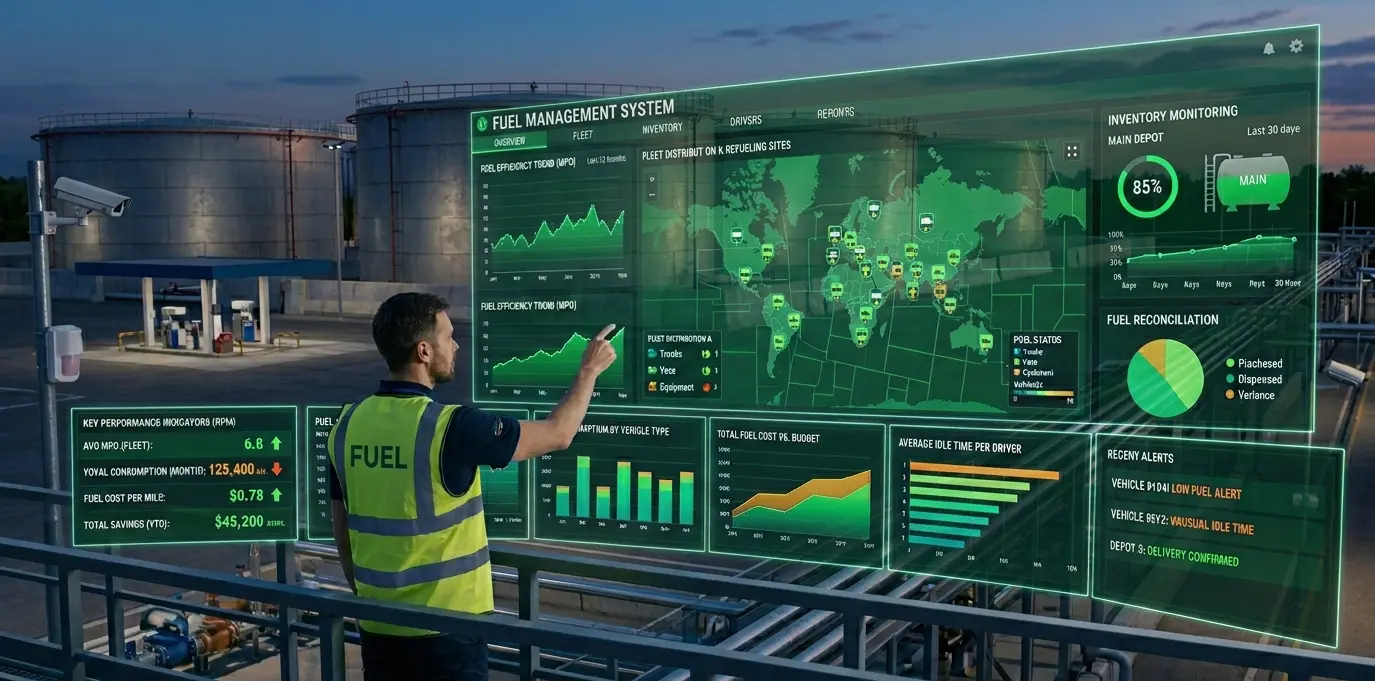
The output that matters to most users is the web-based dashboard, accessible from any device (phone, tablet, or desktop) with an internet connection.
From the dashboard you can:
- Live tank levels: visible across all sites simultaneously
- Transaction history: searchable and filtered by site, vehicle, operator, date, or volume
- 30+ standard reports: covering consumption per asset, cost-per-kilometre or cost-per-hour, period comparisons, and exception reporting
- Alert thresholds: low-level warnings, after-hours dispensing, unusual transaction volumes, and more
- SMS and email notifications: for any alert event, delivered in real time without requiring anyone to be logged into the dashboard
For operations with existing telematics or ERP platforms, API integration allows fuel data to flow automatically into those systems, eliminating manual data entry and keeping all operational data in one place.
How the Components Work Together: A Single Transaction
It helps to trace a single dispensing event through the full system to see how the components interact:
- A driver approaches the dispensing point. If BLE vehicle identification is enabled, the controller detects the vehicle’s tag automatically.
- The driver authenticates using their key tag or PIN. The controller validates the credential.
- If valid, the solenoid valve opens and the flow meter begins recording. The driver enters the current odometer or hourmeter reading on the keypad.
- Fuelling completes. The solenoid closes. The flow meter records the final volume.
- The transaction record (timestamp, operator ID, vehicle ID, volume, odometer/hours) is transmitted via GSM or Wi-Fi to the cloud server within minutes.
- The tank level sensor records the corresponding drop in tank volume.
- The cloud server compares the dispensed volume against the tank level change and flags any discrepancy outside tolerance.
- If any configured alert rule is triggered (after-hours dispensing, volume above threshold, tank level below minimum), an SMS and email notification is sent immediately.
- The dashboard updates. The transaction is visible in reports.
The entire process from step 1 to step 9 is automatic. No paper log, no manual data entry, no month-end reconciliation from memory.
What the System Does Not Do
A fuel management system controls and records dispensing from installed hardware. It does not manage fuel card transactions at third-party service stations. For fleet operators who fill at public pumps, a separate fuel card management solution is needed to cover that portion of consumption. The two can be integrated, with fuel card data and on-site data presented on a single dashboard, but they are distinct systems.
R2D Fuel designs and installs fuel management systems for operations of all sizes across South Africa and the broader region. Our systems monitor up to nine tanks simultaneously with 1-litre accuracy, support both GSM and Wi-Fi communication, and include real-time alerts, 30+ comprehensive reports, BLE vehicle identification, and full API integration. Contact us to discuss your site requirements.