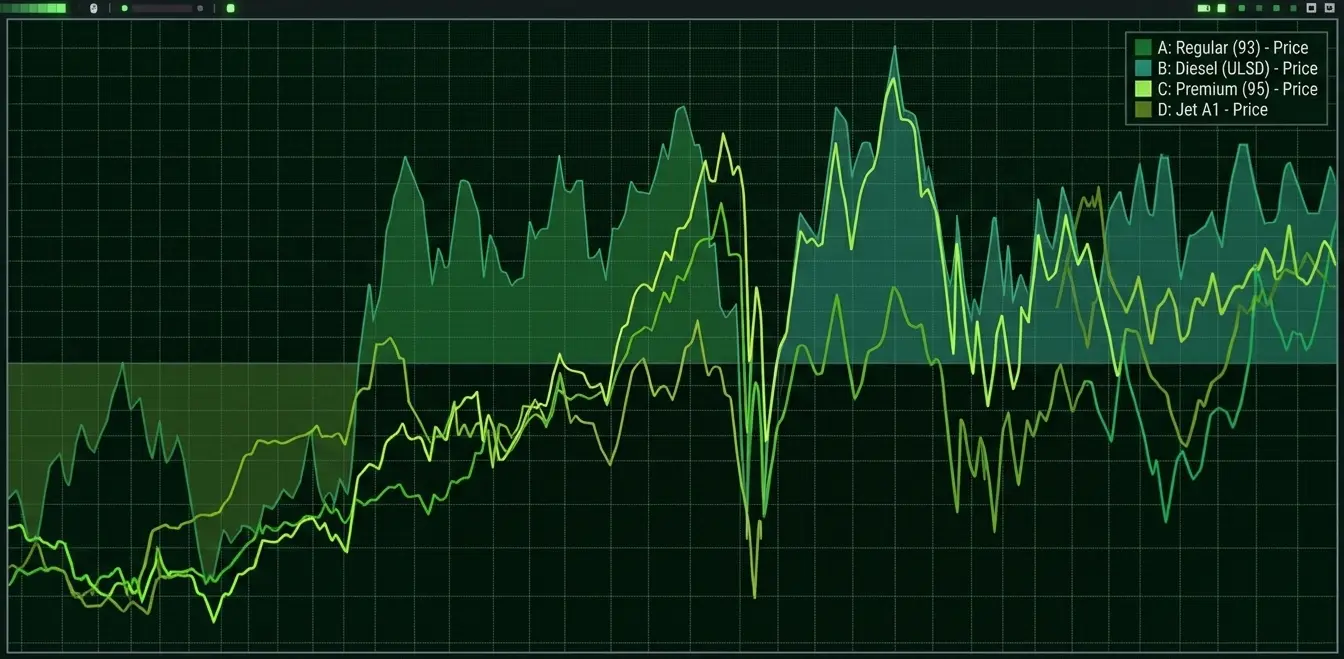
How Is the Pump Price Determined?
South Africa’s fuel pump price is not simply set by the government or oil companies, it is the result of a structured formula managed by the Department of Mineral Resources and Energy (DMRE) and informed daily by the Central Energy Fund (CEF).
The final price at the pump is made up of several components:
- Basic Fuel Price (BFP): the largest component, based on the cost of importing refined fuel
- Fuel Levy: a fixed government tax per litre
- Road Accident Fund (RAF) Levy: funds the Road Accident Fund
- Wholesale margin: the fuel company’s margin
- Retail margin: the service station’s margin
- Transport costs and customs duties: additional levies covering inland transport and import duties
What Is the Basic Fuel Price?
The BFP is calculated daily by CEF based on two key inputs:
- International product prices: the cost of petrol and diesel on the international market (typically the Mediterranean and Arab Gulf benchmarks), quoted in US cents per gallon
- Rand/Dollar exchange rate: crude oil and refined products are priced in US dollars, so a weaker rand directly increases the BFP
This is why fuel prices in South Africa can change even when global oil prices stay flat; a depreciating rand pushes costs up.
What Does “Over/Under Recovery” Mean?
You’ll see this term in the CEF daily report. The over/under recovery is the difference between:
- Current pump price: what the fuel was actually priced at for consumers
- BFP-calculated cost: what it should cost based on today’s BFP
A negative (under-recovery) means the current pump price is lower than the current cost, meaning fuel companies are effectively selling at a loss relative to the international price. This typically leads to a price increase at the next adjustment.
A positive (over-recovery) means the pump price is higher than current costs, which typically leads to a price decrease.
CEF publishes this figure every business day, giving the market a real-time signal of where the next monthly adjustment is heading.
Why Does This Matter for Your Business?
For fleet operators, mines, agriculture businesses, and construction companies that consume significant volumes of fuel, even a small per-litre movement has a meaningful bottom-line impact.
Tracking the daily CEF data, particularly the cumulative over/under recovery as the month progresses, gives you advance warning of likely price changes so you can:
- Procurement timing: plan bulk purchasing ahead of expected price increases
- Cost forecasting: adjust project budgets based on likely adjustments
- Budget accuracy: manage fuel spend with advance warning of price movements
R2D Fuel publishes the latest daily CEF data on this page so you always have access to the most current figures without having to track down the PDF yourself.